 By Yuko Kurahashi / Photos Courtesy San Diego Repertory Theatre
The world-premiere of Hershey Felder’s Our Great Tchaikovsky (directed by Trevor Hay and dramaturged by Meghan Maiya) at the San Diego Repertory Theatre’s Lyceum Stage portrays Pyotr Ilyich Tchaikovsky’s life (1840-1893) and music.
During the show’s run (January 12-February 12), the Repertory Theatre is also exhibiting the work of Boris Malkin (1908-1973) in its newly renovated gallery. A Belarusian (formerly the Soviet Union) artist, Malkin created hundreds of works ranging from oil paintings, watercolors, drawings to wood sculpture and scenic design. The exhibition serves as a wonderful preshow.
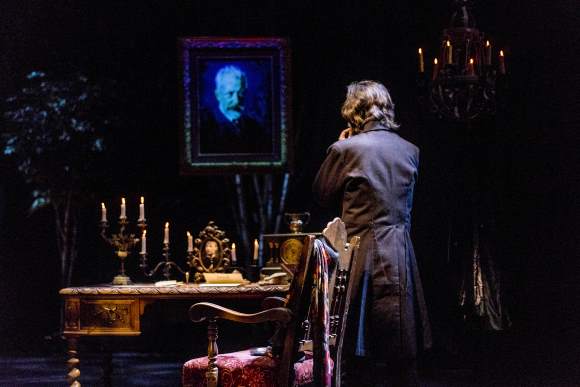
With his designers, Felder has created a stunning stage setting with period pieces such as a desk, chair, bookcase, candles in candleholders, and a samovar. Center stage is a grand piano with trees and a cyclorama behind. On the cyclorama, lighting and projection designer Christopher Ash projects various still and moving images including birch trees, birds, a Russian Orthodox church, a dacha, fireworks, and dancers in The Nutcracker. Above the desk hangs a picture frame on which to project people from Tchaikovsky’s life.
Felder touches upon key events and relationships in Tchaikovsky’s life not only to inform the audience of the composer’s life but also to deepen the audience’s understanding of Tchaikovsky’s sufferings, pain, fear, depression, and love.
As the show starts, Felder enters the stage with a letter in his hand. This, Felder explains, is an invitation letter from an art organization in Moscow to perform his new piece about their “Great Tchaikovsky.” Felder speaks to the audience: “This is the most frightening letter I have ever received.”
Felder’s description about current policies on sexual relations in Russia clarifies why. In 2013 it passed an anti-LGBTQ federal statute, banning “propaganda of non-traditional sexual relations” on top of another anti-LGBTQ bill which bans same-sex couples from adopting children. This “contemporary” scene segues to the story of Tchaikovsky who composed music under the fear of institutionalized persecution for his homosexuality.
Felder then puts on a scarlet-color vest (designed by Abigail Caywood) and takes his audience to the world of a young Tchaikovsky living with his family in their dacha in Votkinsk, 600 miles east of Moscow. As a small child, Tchaikovsky learns music from his mother Aleksandra. In spite of the opposition of his father, Tchaikovsky continues to play music, which becomes his means of expression.
At the age 10 he is sent to the Imperial School of Jurisprudence in St. Petersburg to become a civil servant. After working for a few years as a clerk in the Ministry of Justice, Tchaikovsky quits his job to study music at the St. Petersburg Conservatory run by Anton Rubinstein. After graduating from the Conservatory, he works with Nikolai Rubinstein, Anton’s brother. According to Felder (as Tchaikovsky), Nikolai is able to turn “everything he sees into art.”
Felder also narrates, with humor, Tchaikovsky’s defiance against the pressure from musical nationalism championed by the “Mighty Handful,” a group of Russian composers. During the episode in which Mily Balakirev, the leader of this group, trashes Tchaikovsky’s Piano Concerto no.1, Felder performs the tumultuous exposition of this piece, playing both the orchestra and piano parts. This illuminates Tchaikovsky’s tenacity and integrity as well as celebrating his artistic victory; it premiered in Boston and later worldwide and soon after Balakirev began to perform it with pride and joy.
The attraction of Our Great Tchaikovsky lies in Felder’s interpretation of this great composer and his ability to theatricalize it within the historical, literary, and artistic contexts. For example, Felder, as Tchaikovsky, calls the “1812 Overture” just an amalgam of noisy sound written on commission for the 1882 All-Russia Arts and Industry Exhibition in Moscow.
Felder tells the audience that Tchaikovsky wrote this bombastic piece for the money. Felder’s dynamic touches on the piano accompanied by the recorded orchestra (sound designer Erik Carstensen) filled the entire stage with the sounds of bells and cannons. The music’s magnanimity is further invigorated by projected fireworks which reflect on the trees in different colors.
His interpretation of the Symphony no.6, The Pathétique (premiered in October 1893), is equally intriguing. Tchaikovsky composed the piece for his beloved nephew Vladimir “Bob” Davydov, who was “like him.” Sorrowful and quiet movements followed by unpredictable, emotional melodies in this symphony envisage Tchaikovsky’s death nine days after its premiere.
 Felder concludes Our Great Tchaikovsky with a “ritualistic” transformation from a young to an older Tchaikovsky, first asking the audience if he should accept the invitation. His own answer is: “I think I should.” Then Felder puts on a beard and a wig in order to resemble the portrait of Tchaikovsky in the picture frame, beginning to play Symphony no.6 as the stage gets darker and darker.
Felder has created and performed a number of his original “story-telling” pieces in which he narrates and plays the piano. In July 2017 at the San Diego Repertory Theatre, Felder presented Maestro, which captures key moments in Leonard Bernstein’s life. His other works include George Gershwin Alone, Monsieur Chopin, Beethoven, As I knew Him; Franz Liszt in Musik, Hershey Felder as Irving Berlin, and An American Story, for Actor and Orchestra. Felder also adapted and directed Mona Golabek’s The Pianist of Willesden Lane.
Our Great Tchaikovsky runs through February 12, 2017 at San Diego Repertory Theatre’s Lyceum Stage followed by performances at Laguna Playhouse, March 1-26, 2017.

Yuko Kurahashi
Latest posts by Yuko Kurahashi (see all)
- From Encounter to Fade-out: Moxie Theatre’s ‘Fade’ by Tanya Saracho - November 5, 2018
- Politics, Reality, and Invention at the Time of Trial: San Diego Repertory Theatre’s ‘Actually’ - November 2, 2018
- Refugees Cast in ‘The Jungle’, an Earnest Play about Migrant Camp Life in Calais - September 13, 2018
