By Bob Dorn
 Apparently, we made it through the Apocalypse. It wasn’t the most recent one, predicted to accompany the exhaustion of the Mayan and Olmec peoples’ Long Count calendar last December. Instead, it was the one so many of us lived through starting some 50 years ago, the one we like to say lasted a decade, the 60s.
Back then, half of us seemed to aspire to higher consciousness and the other half of us learned to run from people who told us to travel astrally, or to go to Vietnam to kill Vietnamese, or to get a PhD in business management or to go out of our minds simply to find out what that might be like.
Predictions of the ultimate disaster seemed common, but they were just the first drops in the cascade of apocrypha that was to follow. From 1970 on, more than 70 warnings of Armageddon have flowed from people as famous as Pat Robertson and Jerry Falwell and as infamous as Jim Jones, but they’ve all been busted by the universe’s refusal to collapse. Even the sort of limited but scary helter skelter dubbed Y2K by various IT illuminati failed to materialize at the turn of the millennium, making the 0 and 1 crowd seem, merely, … technocratic. (I can’t remember them apologizing for their mistake. )
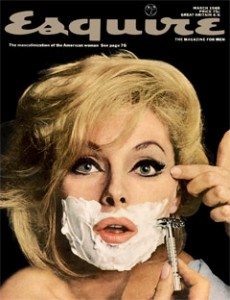 Our gullibility in the face of war, popular metaphysics, dietary and sexual experimentation, digitalia, Walmartian acquisition and on to compulsive money- grubbing may not have been fully explained but it was made clearer by Esquire Magazine, back in those 60s. No one deserves more credit for the magazine’s graceful but brash diagnostics of what America had been eating and what was eating it than its editor-in-chief during that decade, Harold Hayes.
Esquire, and Hayes, are the subject of a documentary making its way through the Palm Springs Film Festival this month wearing the title Hayes so many years ago gave the magazine’s retrospective of the 60s, “Smiling Through the Apocalypse,” a collection of writing that included probably the decade’s best journalism. It is a nearly seamless mixture of still photos, 15 mm. black and white home movies, hand-held camera and full color video interviews of writers and editors and art directors put together by Hayes’ son, Tom, who’s somehow a presence in the film –- probably because the filmmaker wanted to reveal Hayes as both a workaholic and a loving father.
Before Hayes’ arrival, Esquire had been a strange mixture of high and low culture (called in the publishing trade a “gentleman’s magazine”) that allowed Alberto Vargas’ painted nudes to nestle between fiction by Hemingway and Faulkner and book reviews by John Steinbeck and Dorothy Parker. Named editor in 1961, Hayes brought with him cheeky, needle-pointed non-fiction that broke through the barriers separating journalism and art, a merger of the real and imagined that made readers sprint for the mailbox, breathless for the month’s revelations.
The likes of writers like Gay Talese, Tom Wolfe, Nora Ephron, Brock Brower, Garry Wills – all of them risen masters of The New Journalism – talk about Hayes and the magazine on camera, making it clear that they never felt freer to test the limits of non-fiction than they did under Hayes’ editorship.
A white son of the genteel South, this editor did not shy from risk at a time when America had become comfortably pretentious. Hayes assigned the unlikely trio of Jean Genet, Terry Southern and William Burroughs to Chicago to cover a Democratic Party convention that nominated Hubert Humphrey and shattered the party. For one Christmas issue he convinced heavyweight champ Sonny Liston to don Santa Claus’ red sock hat and stare out balefully from the cover.
After the My Lai massacre in Vietnam but before his own murder trial, Lt. William Calley, was persuaded to sit amongst a handful of Vietnamese children who stared, emotionless, at the photographer. The art director remembers giving Hayes two choices; one of Calley smiling, the other not. Hayes chose the smile.
Sometimes Hayes would just let reality burn through the pages, relentless and unrelieved. When he secured the serialization of Norman Mailer’s fourth novel, An American Dream, the editor didn’t know he was committing himself to a radically profane piece of work, but he stood up under Mailer’s assaults, at one point telling the writer, “Okay, I’ll trade you three ‘shits’ for one ‘fuck’.”
John Sacks’ article on a group of soldiers in Vietnam unleashing firepower on innocents bore the stark single letter “M,” (for M Company) and the quote, “Oh, my God, we hit a kid.”
The film convincingly demonstrates that Hayes managed to unite illustration and written text in ways that left no ambiguity or doubt, and forced staffers to stretch to satisfy him. “You had to either make him laugh, or shock him, or surprise him,” one of them explains.
 The marriage of humor and suppressed outrage was the prescription for a lot of covers. One of three articles Hayes ordered on Muhammad Ali came just after the champ had been stripped of his title and barred from boxing for having refused induction into the Army and the decade’s worst war. For the cover, the art director dressed the champ in boxing trunks and showed him pierced by six arrows, much as the Catholic martyr San Sebastian is depicted in church art, though in different flesh. The art director remembers showing the stills of the photo to the champ and — in a fair imitation of the champ’s hoarse patois –says Ali feigned surprise: “But… Saint? Saint Sebastian? He’s… Christian!” And, adds that Ali touched each arrow, giving it a name… Lyndon Johnson, William Westmoreland, Hubert Humphrey… The equivalent today might be if TIME or The New York Times were to substitute Corporal Bradley Manning, or Julian Assange, for Saint Sebastian.
That kind of stylish editorial courage seems to be in short supply these days. When I asked Tom Hayes what current magazines he thinks might demonstrate his father’s willingness to get beyond the merely acceptable and on to more important new angles on the truth, the director seemed flummoxed, and said something about not many. He mentioned The Oxford American, for its literary quality, and the New York City-centric Observor for its irreverence, but no others, not even Rolling Stone.
The festival, which lasts until January 13, has shown the film three times. The poster for it is superimposed with the words, “Coming Soon.” Maybe that will be true for one or two San Diego theaters. It should.

Source
Latest posts by Source (see all)
- And Then They Came for the Vietnamese… - December 13, 2018
- Amazon’s Disturbing Plan to Add Face Surveillance to Your Front Door - December 13, 2018
- 140+ Arrested as Youth-Led Protests Demand Green New Deal on Capitol Hill - December 11, 2018

When are we going to get more independent theaters in San Diego showing good movies? We have the Landmark Hillcrest and La Jolla theaters where we mostly go because the mainline theaters with a few exceptions are showing almost exclusively violent fare. Most of the good movies are foreign productions. And for the numerous theaters in San Diego, they mostly all replicate the same movies so no matter what neighborhood you live in, you can go to see the same shoot-em-up at a theater near you. Lincoln was a fine film which got general distribution, but another Oscar contender Silver Linings Playbook was limited to just a few theaters, perhaps because there was no violence in it.
You know there’s a Landmark in Kensington (Ken Cinema). That one tends to show even more edgy/obscure/indi(ish) movies than the other two you mentioned.
Bob- thanks for this really smart review- punchy & incisive. As a budding “intellectual” in the 60’s, Esquire (and Playboy) interviews and long form writing were required reading. I have to confess that Hayes’ edgy covers went over my youthful head. (Esquire also planted the seeds of my budding feminism, but that is another story…)
Charles Pierce is one of my favorite journalists/ political bloggers and I don’t miss a day reading him on Esquire.