By John Lawrence

(Credit: Sue Gardner / Wikimedia)
Thomas Piketty’s new book Capital in the Twenty-first Century begs comparison with Karl Marx’Das Kapital written in 1867. The two books are alike in the sense that they both point out the incredible centralization and concentration of wealth in fewer and fewer hands. They are unlike in the sense that Marx’ book is more exhortatory while Piketty’s is more of a massive collection of historical data presented in the form of numerous graphs and charts.
While Marx was more of a “workers of the world unite, you have nothing to lose but your chains” kind of guy, Piketty is a Dragnet’s Sergeant Joe Friday’s “The facts, ma’am, just the facts” kind of guy. While Marx’s solution to the dilemma of inegalitarianism was revolution and the dictatorship of the proletariat, Piketty’s is a global tax on wealth, something that even he concedes is unlikely to happen.
Piketty’s main theme is that up until the advent of the First World War, wealth was concentrated in the hands of the upper decile (upper 10%) and particularly in the hands of the upper centile (upper 1%). In 1910 the top decile held about 90% of the wealth in Europe and 80% in the US in what was known as the Gilded Age in the US and the Belle Epoque in France. The dislocations of WW I, the Great Depression and WW II tended to equalize wealth and incomes so that the period from roughly 1914 to 1975 was the era when the middle class made its greatest advances in both wealth and income. Since 1980, however, the age of Reaganism and Thatcherism, the upper decile and centile have taken off in wealth and income so that at the present time their wealth accumulation is approaching the same level as it was during the Gilded Age. As of 2010-2011, the upper decile in the US owns 72% of America’s wealth while the bottom 50% owns just 2%.
Piketty points out that what happened in 1980 under Reagan and Thatcher was that income tax on the upper income brackets was drastically reduced. While the top marginal income tax rate was 70% under President Clinton, it was reduced to 28% under Reagan. Taxes on capital gains were also drastically reduced while FICA (social security) taxes affecting mostly the middle class and poor were raised. This incentivized the pay of CEOs to skyrocket to the point where some CEOs today in the fast food industry are making over 1000 times what the average fast food worker is making. While income taxes are largely progressive, FICA taxes are flat affecting incomes at the same rate all the way down to zero dollars of income with no deductions and no exemptions.
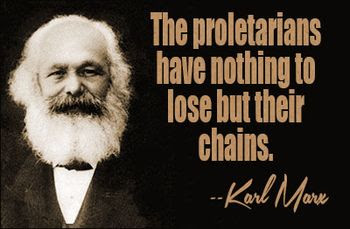
Marx also believed in historical determinism and thought that it was inevitable that the next stage in history was a revolution that would lead to the dictatorship of the proletariat. In that stage workers would have overthrown the capitalists and would reap all the rewards of their labor instead of having them siphoned off by the capitalist parasites. However, the Soviet experiment didn’t work out quite as Marx had envisioned. If nothing else it proved that nothing is historically inevitable. The Soviet state expropriated all private wealth and held it on behalf of the workers. In the Soviet world the government held 100% of the wealth of the society and privately held wealth was zero just the opposite of historical wealth accumulation prior to 1917. Elsewhere in the world the share of wealth privately held by the upper decile diminished after WW I and the share held by the middle class, mainly in the form of real estate, increased.
Prior to 1917 privately held wealth represented approximately 100% of national wealth in most countries and government held net wealth was close to zero similar to the situation that exists today in the US and most European countries. To the extent that national debt represents money owed by citizens to bondholders, it can be seen primarily as a transfer of income from the middle class to the rich. Thus the wealthy supply the funds necessary to run the government not by means of taxation but by loaning the government the money from which they get paid interest. Norway which has a sovereign wealth fund is the exception. Norway puts profits from its oil extraction industry into a fund from which it pays Norwegians’ pensions among other things. Norway’s government enjoys a position of net wealth whereas the US government has a net position of zero.
From the point of view of wealth accumulation, the Soviet experiment turned out to be an historical aberration. Piketty is quick to point out that no distribution of wealth and income is historically inevitable putting the lie to the doctrine of historical determinism. I say Good Riddance. No workers’ paradise will come about as a result of historical inevitability nor will it come about as a result of benign tendencies within the capitalist system. In fact the liklihood is the opposite: the 1% will keep getting wealthier while the 99% will keep losing ground. The Trente Glorieuses, the 30 years when the middle class prevailed from 1945 to 1975, is over.
Piketty states:
Modern economic growth and the diffusion of knowledge have made it possible to avoid the Marxist apocalypse but have not modified the deep structures of capital and inequality – or in any case not as much as one might have imagined in the optimistic decades following World War II. When the rate of return on capital exceeds the rate of growth of output and income, as it did in the nineteenth century and seems quite likely to do again in the twentyfirst, capitalism automatically generates arbitrary and unsustainable inequalities that radically undermine the meritocratic values on which democratic societies are based.
So while Marx believed in the expropriation of the expropriators by the working class, Piketty points out that the wealthy are only increasing their share of national wealth while the 99% are losing both income and wealth. The owners of capital are increasing the percentage of national and world wealth that they own while the value of labor is decreasing. Piketty doesn’t, however, give an analysis of why a bigger share of income is going to capital and a smaller share to labor. The overriding dynamic is that there is less of a need for labor as robotization and automation take over more and more of the tasks involved in creating consumer products. By the law of supply and demand, the fewer workers that are needed, the more the owners of capital can bid down their services. Since the only way most of the middle class can earn income is from their labor, there is a greater and greater return to the owners of capital and less and less to labor – particularly the labor of the former middle class and poor – the lower nine deciles.
Where Piketty and Marx agree is that capitalism is a system which tends to concentrate income and especially wealth into fewer and fewer hands. Thus inequality tends to increase, not decrease, as time goes on. The period between the two world wars and the Trente Glorieuses was an exception to the rule because of the dislocations caused by war and the Great Depression.
 The long sought for utopian goal of a world in which labor is performed mostly by machines and the average person would have a life of leisure and material comfort is contradicted by the fact that, for the 99%, their only form of income is from their labor. As the need for their labor diminishes, so does their income so that instead of a life of material comfort without the need for labor, they have a life defined by unemployment and diminished means of acquiring material goods. This is the contradiction of advanced capitalism. As Piketty points out, there are two types of income: income from labor and income from wealth. If wealth were more evenly distributed, the 99% could derive part of their income from wealth instead of a diminished income from labor. I have pointed out elsewhere how this might be possible.
The cooperative movement might also be an antidote to the perverse situation we find ourselves in that, as our labor is less needed to produce the material means of a comfortable life, our income to purchase those things is also diminished. In a cooperative like Mondragon, workers acquire a position of ownership so that profits go to worker/owners and not just to the owners of capital. In Mondragon capital is withheld on behalf of workers in order to pay for pensions rather than being accumulated individually by workers which may or may not be preferable on a long term basis.
From Wikipedia:
The Mondragon Corporation is a … federation of worker cooperatives based in the Basque region of Spain. It was founded in the town of Mondragon in 1956 by graduates of a local technical college. … It is the seventh-largest Spanish company in terms of asset turnover and the leading business group in the Basque Country. At the end of 2012, it employed 80,321 people in 289 companies and organizations in four areas of activity: finance, industry, retail and knowledge.
At Mondragon, there are agreed-upon wage ratios between executive work and field or factory work which earns a minimum wage. These ratios range from 3:1 to 9:1 in different cooperatives and average 5:1. That is, the general manager of an average Mondragon cooperative earns no more than 5 times as much as the theoretical minimum wage paid in his/her cooperative. [Compare this with the 1000 to 1 ratio between CEO salaries and worker salaries in the fast food industry in the US.] In reality, this ratio is smaller because there are few Mondragon worker-owners that earn minimum wages, because most jobs are somewhat specialized and are classified at higher wage levels. The wage ratio of a cooperative is decided periodically by its worker-owners through a democratic vote.
[The financial area] includes the banking business of Caja Laboral, the insurance company Seguros Lagun Aro, and the Voluntary Social Welfare Body Lagun Aro, which had an asset fund totalling €4.2 billion at the end of 2009. The yield obtained from this fund is used to cover long-term retirement, widowhood, and invalidity benefits, complementary to those offered by the Spanish social security system.
While Mondragon’s capital assets are used in a laudable manner, if it were put to a vote in the US, I would wager that most citizens would prefer to own wealth in their individual accounts rather than having it held for them by a cooperative, no matter how benign. The one main benefit of individual ownership is that wealth can be passed on to heirs whereas wealth held in the cooperative account will not be.
Piketty’s notion of a global tax on capital is not realistic since capital seeks out secretive banking services in Switzerland and elsewhere. A Financial Transactions Tax is more realizable. Any tax on wealth needs to be taken at the point of contact with the financial system, just as income tax is deducted directly from a worker’s paycheck, in order to make it practicable.
Property taxes also represent a tax on wealth since, as Piketty points out, wealth in the developed world is held about 50% in real estate and 50% in financial assets. Real estate is taxed at a flat rate in the US. Property taxes are very practicable as taxes on wealth since they have been in place for many years. They need to be made progressive, however, in order that the middle class can gain a greater share of wealth and income. A Federal property tax could be simply added onto the local property tax keeping it low for the middle class and higher for the wealthy. Thus there are various ways to practicably tax wealth without having to access bank records. A progressive property tax could allow seniors to remain in their homes instead of having to sell because they can’t afford their property taxes.
Corporate income and capital gains taxes, which were slashed under Reagan and Thatcher, need to be raised and made more progresssive in order to reduce inequality. Progressivity will reduce inequality. FICA taxes, flat taxes which affect mainly the middle class and poor, need to be made progressive and the cap needs to be raised. Right now the rich pay effectively no FICA taxes since the cap on income which can be taxed is $117,000. Reagan and Alan Greenspan increased FICA taxes (doubling those of the self-employed) while reducing taxes on high incomes, corporations and capital gains. Carried interest, which is a loophole that only benefits hedge fund and private equity managers, needs to be abolished so that these guys pay their fair share. There are many other ideas about how to lower taxes on the middle class and the poor and raise them on the rich. Tax policy is an effective tool to reduce inequality.
If the 1% were taxed at the same levels they were taxed at during the Trente Glorieuses, inequality could be reduced and the middle class’ share of national wealth could be increased. Government policy also could encourage wealth formation in the lower deciles of the population through micro loans and loans for small business start-ups among other things. This is more likely to happen if states and cities create public banks. Of course a public bank could be established at the national level to replace the Federal Reserve which is privately held by its shareholders, mainly Wall Street banks.
As Piketty points out, if the rate of wealth creation exceeds the rate of income going to labor, the system very soon gets out of whack. A good example of this is the fact that Bill Gates, the richest man in America, earned $9 billion last year from doing nothing or rather, to be more precise, Bill Gates’ wealth earned $9 billion last year. Even though he’s given an astounding $38 billion to his charitable foundation, he keeps getting richer year after year. Obviously, Bill Gates can not spend the $9 billion which was last year’s income from wealth (his income from labor was zero) so it just gets added to the $67 billion pile he had already accumulated.

John Lawrence
Latest posts by John Lawrence (see all)
- Economist Kenneth Arrow, Nobel Laureate, Dead at 95 - March 22, 2017
- Container Ships Burn Dirtiest Fuel: the International Maritime Organization (IMO) Could Change That - March 15, 2017
- Cities and States Prefer Public Banks To Wall Street - March 7, 2017

“…the maintenance of capital is not something which is compatible with a state of complete exhaustive consumption. Once eat your seed-corn, and while you may have a nice warm glow in your belly for that one sweet moment, you will also have ruined your chances of filling it – and filling it many times over, at that – in the course of the following season. Thus we arrive at the presumption that capital is not only first accumulated, but subsequently maintained, by the exercise of some measure of restraint – an act of providential abstinence we tend to refer to as ‘saving’.” -sean corrigan
So far two notion have occurred to me after reviews of Piketty’s book:
labor is being replaced by wealth; and,
war interrupted the death spiral of The Gilded Age.
It looks like we’re going to be getting more war and less wealth if this is
true because the only labor that wealth seems to recognize is that provided
by warriors. We do pay our soldiers, but even here we’ve begun to see “news”
about robot warriors.
A perhaps unrelated concern is the question of currency. When so much
wealth is sequestered and inert, and grows by attracting more wealth, what
use is a dollar, or a pound or…?
It’s true, Bob, that there is a lot of wealth that is just being sat upon. Apple has $150 to $200 billion that it is neither investing nor paying out to “owners” in the form of dividends. Microsoft is sitting on $80 billion, and Google, $50 billion. Individuals such as the Koch brothers, the Waltons and others have so much money they can’t spend it all nor can they find suitable productive investments for it. It’s just money that is being used to make more money without having any useful purpose. This is what the financialization of the economy is all about: not productive investment, but money making money.
The only reason the Fed is not worried about all this money lying around is that there is no wage inflation. In other words the cost of labor is not going up. They want some inflation because this diminishes the amount of the national debt. So they see all the money that the billionaires are sitting on as harmless. It is increasingly divorced from the real economy of buying and selling goods and services. However, a lot of this money is being used to take over the government. Billionaires have an unlimited budget for TV ads and lobbyists.
Even in the military, pilots are being replaced by drones, and, I believe, robot tanks are in the works.
The return on wealth wouldn’t be such a problem if the ownership of wealth were more spread out. If so, the return on wealth would be spent in the economy. But it’s very concentrated in just a few hands with the majority of the work force being reduced to finding jobs in the service economy: fast food, hotel and hospitality workers, janitorial, retail etc.
In some ways I don’t think it is evil for some to be more wealthy than others Except if that wealth is sued to oppress the rest of the peoples ability to build wealth or at least be self sufficient. So the question is whether that is the case in the US. In some cases yes (Koch bros-Walmart folks etc) What the super rich do with their money in terms of social or civic responsibility and whether it enhances the overall welfare of the people is an issue and can be influenced by legislation. Taxing it so the government can build more drones is not the answer. Somehow they should pay for the common good, infrastructure (ie Carnegie and public libraries or Soros with transparency and democracy making) education, job creation,etc. Its kind of a new paradigm vs Marx’s day. Money moves around more fluidly today,like, see how fast they store it offshore.
A little trust busting would also go a long way. Maybe legislation that requires public benefit of super wealth?
Taxing wealth is part of the answer because the alternative is borrowing money from the wealthy to run the government which entails it being paid back to the wealthy primarily by middle class taxpayers.
Here’s what I think is the biggest takeaway from Piketty:
200 years of data shows there is no such thing as a free market mechanism for improving the standard of living for people who work for a living.
The only way to stop the downward spiral in the standard of living is intervention. The government can redistribute wealth thru taxation and/or people can get organized.
And here’s my biggest takeaway: Free markets are at odds with democracy and don’t care much about democratic solutions.
When the amount of wealth one person or a group of persons holds exceeds a certain amount, that person or group can effectively buy the government which is exactly what is happening today. Does that interfere with democracy? You betcha. A new aristocracy is forming, an aristocracy based on wealth. The wealthy are calling the shots through their lobbyists and campaign contributions. When a lobbyist makes more than the President of the US, something is wrong. It’s the tail wagging the dog.
It’s interesting looking at the last financial crisis that one would expect a return to a Keyensian economic cycle. I remember, many people began to purchase texts regarding theses of returning to a compromise between capital and labor. To alleviate the contradiction of the last economic cycle, it seems that there’s a full-blown push towards hyper neoliberalization instead, with things like the TPP. What makes this historical moment quite different as well is the embrace of all western powers of authoritarianism as well.
What still remains more remarkable is the popular fixation of solutions within capitalist frameworks, which seem completely self-destructive. In spatial terms, infinite market growth seems completely unsustainable.
Also interesting to note that Picketty didn’t read Capital but is fine criticizing the text.
http://thecharnelhouse.org/2014/05/06/piketty-and-marx-or-why-no-one-needs-to-read-anything/
Assume the author meant Carter, not Clinton, in the fourth paragraph.
Right, under Eisenhower, Kennedy and Johnson the top tax rate was 91%. It was 77% under Nixon, 70% under Ford and 70% under Carter.
A wealth tax Is an interesting idea that was tried by cyprus. First tax people’s income, then tax what they don’t spend. Savers are already getting burned by interest lower than cost of living increases, people with savings put there funds into equities, bonds and real estate. Money in bank accounts is emergency funds.We already have property taxes. Equities get taxed on dividends or capital gains. Not sure if we want to discourage foreign investment in the us.
So much off “wealth” is in retirement funds like 401k and iras. Wealth tax proposal e ts are preoccupied with their intent of reducing unfairness, not the details or the results. People vote with their feet…
Did you miss the word “progressive” in the discussion regarding taxes? There are different ways that various taxes could be made progressive including with regard to a person’s wealth as well as income. What it would be desirable to do in order to make things more equal is to encourage the little guy to accumulate more wealth while discouraging the big guy who has more than enough to live well on. This would tend to equalize the distribution of wealth. For instance, progressive property taxes would let seniors continue to live in their homes instead of being driven out by property taxes even if their home is paid for.
Property taxes as well as FICA taxes are regressive at the present time.
By the way most of the wealth that was taxed in Cyprus was put in the banks there by wealthy Russians.